
The pump.fun API in 2026: what exists, what doesn't, and how to use it
Does pump.fun have a public API? What its apps call, which pump.fun data you can get (profiles, trades, PnL, callouts) and how to start with curl and Python.
9 min read
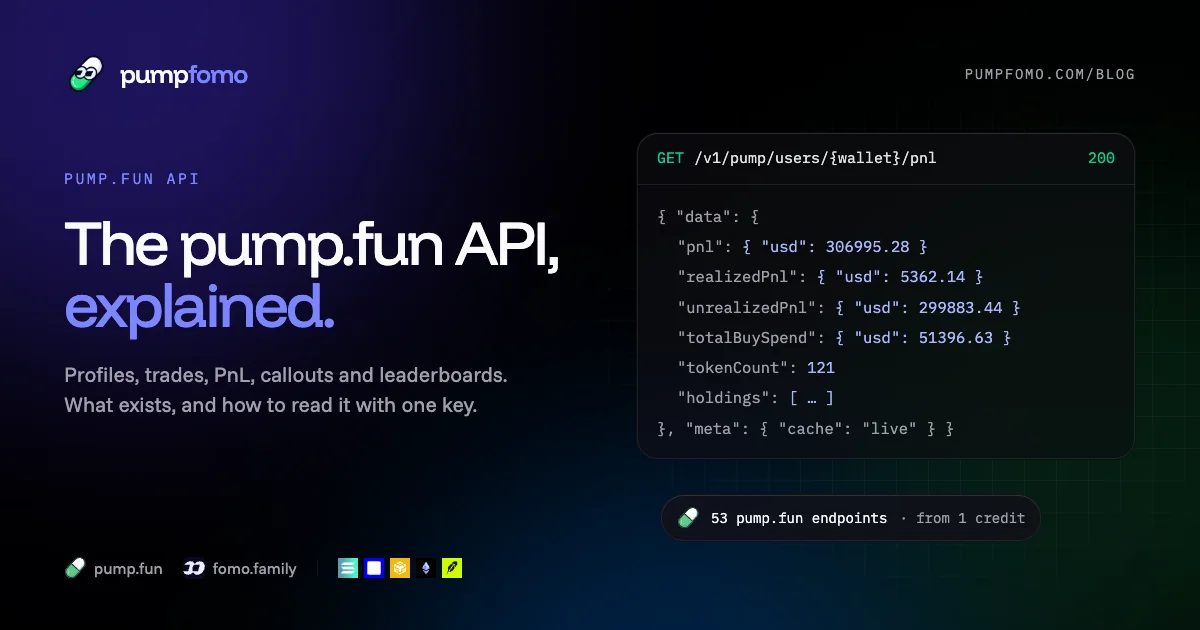
If you searched for "pump.fun API", here is the short answer: pump.fun does not publish a public developer API. There is no documentation portal, no API key you can request from pump.fun, and no promise that anything stays the same next month. Its website and mobile app read from a handful of private hosts, and that is what every "pump.fun API" on GitHub is built on.
This guide covers what those hosts are and which pump.fun data exists. It compares the ways developers get that data and walks you from an API key to working code in curl, Python and JavaScript. We run pumpfomo, a read-only API for pump.fun and fomo.family data, so we'll show our own endpoints. We'll also say where something else fits better.
Is there an official pump.fun API?
No. pump.fun ships apps, not a developer platform. What exists is the backend its own apps talk to, spread over several hosts:
frontend-api-v3.pump.fun: profiles, follows, coins, search and callouts.swap-api.pump.fun: trades, candles and trading stats.- A few more (
profile-api,advanced-indexerand others) for PnL, portfolios and indexing.
You can call some of these from a script, and that is where community projects start. Before you build on them, know what you are signing up for. We learned these points by capturing the traffic of pump.fun's own apps:
- There are no docs or versions. Fields are added, renamed and removed without notice. One answer can mix
snake_caseandcamelCase. - Some routes need a session. pump.fun signs its users in with a JWT, sent as an
auth_tokencookie or anAuthorization: Bearerheader. Profile and coin reads mostly work without it. Anything about "me" and several stats routes do not. - Cloudflare sits in front. It challenges clients that don't look like pump.fun's own apps, so a plain
curlfrom a server often gets an HTML challenge instead of JSON. - Rate limits are per minute and per route.
frontend-api-v3andswap-apisendx-ratelimit-limit,-remainingand-resetheaders, and the reset values point to a 60-second window. Limits we saw range from 30 to 60 requests a minute on common routes.
None of this is a problem for a weekend script. It is a problem for a product that has to keep working, which is why most teams either use a data provider or maintain a client full time.
What pump.fun data exists
pump.fun is two things at once: a token launchpad with an exchange, and a social network of traders. The data splits the same way.
| Data | What you get | pumpfomo endpoint |
|---|---|---|
| Profiles | Username, avatar, bio, follower and following counts, X handle, Solana and EVM wallets | GET /v1/pump/users/{id} |
| A trader's trades | Every buy and sell of a wallet or user, 100 a page | GET /v1/pump/users/{id}/trades |
| PnL | Realized and unrealized PnL in SOL and USD over 1 day, 1 week, 1 month or all time | GET /v1/pump/users/{wallet}/pnl |
| Portfolio | Every position, open or closed, across Solana and EVM chains | GET /v1/pump/users/{wallet}/portfolio |
| Coins | Name, symbol, images, socials, creator, supply, price, market cap | GET /v1/pump/coins/{mint} |
| A coin's trade tape | Every trade in a coin with venue, trader, amounts and USD value | GET /v1/pump/coins/{mint}/trades |
| Candles | OHLCV in USD from 1-second to 1-day bars | GET /v1/pump/coins/{mint}/candles |
| Callouts | A trader's calls: thesis, market cap at the call, best multiple | GET /v1/pump/users/{wallet}/callouts |
| Callout stats | Hit rates (1.2x, 1.5x, 2x) and how followers did after 1h, 4h and 24h | GET /v1/pump/users/{wallet}/callout-stats |
| Leaderboards | Top 100 by PnL (daily, weekly, monthly), streaks, payouts | GET /v1/pump/leaderboard |
| Creator fees | Fees a creator earned, day by day, and the coins they share fees in | GET /v1/pump/users/{wallet}/fees |
| Live trades | Every trade on Solana and 11 EVM chains, as it happens | WebSocket stream |
The table has 12 rows; the reference lists 53 pump.fun endpoints in total, every one with a real captured answer.
On-chain data vs. pump.fun's social layer
This is the decision that matters most, so it is worth being precise about.
On-chain data is anything you can read from Solana or an EVM chain: token launches, bonding-curve trades, graduations to an AMM, prices, holders, transfers. You can index it yourself with an RPC node or a Geyser plugin. Several companies sell it ready-made: Bitquery, Codex, Solana Tracker, Moralis and Helius all cover pump.fun tokens well. If your product is a price chart, a launch sniper or a holder scanner, one of them (or your own indexer) is the right tool.
The social layer lives only in pump.fun's database: usernames and avatars, who follows whom, callouts and the theses written on them, the PnL leaderboard, competitions, trading streaks, creator-fee shares. No block explorer will tell you that a wallet belongs to a trader with 40,000 followers, or that their last six calls hit 2x half the time. If your product is about people (tracking traders, ranking callers, building a social feed, copy trading), you need this layer, and it only comes from pump.fun's own backend.
Most real products need both: on-chain trades and prices, joined to the people behind the wallets. That join is what pumpfomo is built around.
Your options, compared
| Social data (profiles, followers, callouts) | Trades and prices | PnL and leaderboards | Upkeep | |
|---|---|---|---|---|
| Your own indexer (RPC or Geyser) | No | Yes, every program you parse | You compute it | High: every pump.fun program and chain |
| On-chain data APIs | No | Yes | Some (computed from the chain) | Low |
| Calling pump.fun's hosts yourself | Yes | Partly | Yes | High: sessions, Cloudflare, changes |
| pumpfomo | Yes | Yes, with the trader attached | Yes, pump.fun's own numbers | Low |
pumpfomo is read-only. It does not place trades or sign anything. If you want to buy and sell, you need a trading API or your own transactions against pump.fun's programs; pumpfomo gives you the data to decide what to trade.
How to get a pump.fun API key
pump.fun itself has no keys to hand out. With pumpfomo, it takes about a minute:
- Go to pumpfomo.com/signin and sign in with a wallet (Phantom or any EVM wallet) or with Telegram. No email or card.
- In the dashboard, open Keys and create one. It starts with
pf_live_and is shown once, so copy it somewhere safe. - The Free plan gives you 10,000 credits a month at 2 requests a second. Most pump.fun reads cost 1 or 2 credits, so that is enough to build and test.
Give each key only the scopes it needs (read:pump, read:fomo, read:wallet, stream). You can limit a key to your server's IP ranges. Keep keys on the server: a key shipped in a browser bundle is a key anyone can copy.
Your first pump.fun API calls
Every request sends the key in Authorization: Bearer (or X-API-Key). The base URL is https://api.pumpfomo.com.
curl: a trader's PnL
curl -s "https://api.pumpfomo.com/v1/pump/users/4UrFSCrGxgoCtCUBAEZq7ZmPK3Pczkxx7PwYnkBMi1KR/pnl?period=1w" \
  -H "Authorization: Bearer $PUMPFOMO_KEY"
The answer wraps pump.fun's data in data, and meta says where it came from and how fresh it is:
{
  "data": {
    "wallet": "4UrFSCrGxgoCtCUBAEZq7ZmPK3Pczkxx7PwYnkBMi1KR",
    "pnl": { "sol": 3215.28, "usd": 306995.28 },
    "realizedPnl": { "sol": 21.68, "usd": 5362.14 },
    "unrealizedPnl": { "sol": 3193.6, "usd": 299883.44 },
    "totalBuySpend": { "sol": 21.69, "usd": 51396.63 },
    "tokenCount": 121,
    "holdings": [{ "chain": "solana", "mint": "6GmAFSYs…", "valueUsd": 1265928.37 }]
  },
  "meta": { "source": "pump.fun", "cache": "live", "fetchedAt": "2026-10-25T23:10:31Z" }
}
That is a real answer from the week it was captured, trimmed. Notice how much of the PnL is unrealized: one large open bag. That matters if you rank traders by PnL, and we come back to it in the copy-trading guide.
Python: every trade of a wallet
Trades come 100 a page, newest first. Pass the last page's nextCursor to get the next one:
import os
import requests

BASE = "https://api.pumpfomo.com"
HEADERS = {"Authorization": f"Bearer {os.environ['PUMPFOMO_KEY']}"}

def trades(wallet, pages=5):
    cursor = None
    for _ in range(pages):
        params = {"types": "trades"}
        if cursor:
            params["cursor"] = cursor
        r = requests.get(f"{BASE}/v1/pump/users/{wallet}/trades",
                         headers=HEADERS, params=params, timeout=15)
        r.raise_for_status()
        page = r.json()["data"]
        yield from page["trades"]
        cursor = page.get("nextCursor")
        if not cursor:
            break

for t in trades("4UrFSCrGxgoCtCUBAEZq7ZmPK3Pczkxx7PwYnkBMi1KR"):
    side = "BUY " if t["isBuy"] else "SELL"
    print(t["timestamp"], side, t["mint"], round(t["amountUsd"], 2))
Each trade has tx, isBuy, timestamp, amountUsd, amountSol, baseAmount, priceUsd, mint and chainId. A page costs 2 credits whatever its size.
JavaScript: a coin and its last hour
const BASE = "https://api.pumpfomo.com"
const headers = { Authorization: `Bearer ${process.env.PUMPFOMO_KEY}` }

async function get(path) {
  const res = await fetch(BASE + path, { headers })
  if (!res.ok) throw new Error(`${res.status} ${await res.text()}`)
  return (await res.json()).data
}

const mint = "6GmAFSYs4gk3FDao5FzzySQpPZaWsa4rUJHacpMpUNgx"
const [coin, activity] = await Promise.all([
  get(`/v1/pump/coins/${mint}`),
  get(`/v1/pump/coins/${mint}/market-activity`),
])
const hour = activity["1h"]
console.log(coin.name, coin.symbol, Math.round(coin.usd_market_cap))
console.log(`1h: ${hour.numTxs} trades, $${Math.round(hour.volumeUSD)} volume,`,
  `${hour.numBuyers} buyers / ${hour.numSellers} sellers, ${hour.priceChangePercent.toFixed(1)}%`)
Market activity gives trades, volume, buyers, sellers and price change over 5 minutes, 1 hour, 6 hours and 24 hours. For up to 50 coins at once there is a batch version.
pump.fun on EVM chains
pump.fun is no longer Solana-only. Coins also trade on Base, BNB Chain, Ethereum, Robinhood Chain, Monad, Arc and X Layer, and the live stream also carries MegaETH, Polygon, Ink and HyperEVM. For an EVM coin, the mint is a 0x address, and pump.fun needs to know the chain. Pass it as an EVM chain id:
curl -s "https://api.pumpfomo.com/v1/pump/coins/0x2E8c31162b855A2ffa90F6F8634643Ad6F111e18/trades?chain=4663" \
  -H "Authorization: Bearer $PUMPFOMO_KEY"
The ids are 8453 (Base), 56 (BNB Chain), 1 (Ethereum), 4663 (Robinhood Chain), 143 (Monad), 5042 (Arc) and 196 (X Layer). Wallet-level routes like balances, portfolio and PnL already span every chain pump.fun knows, so they don't need it.
Rate limits, credits and errors
Every answer carries what it cost and what is left:
X-Credits-CostandX-Credits-Remaining: the price of this call and your balance after it.RateLimit-Limit,RateLimit-RemainingandRateLimit-Reset: your key's bucket. A429comes withRetry-After.X-Request-Id: quote it if you ever need support.
Prices are in credits:
| Call | Credits |
|---|---|
| Profile, coin, holder count, ATH, SOL price | 1 (SOL price is free) |
| A page of trades, a coin's trade tape, candles | 2 |
| Wallet PnL or PnL chart | 5 |
| A lookup that finds nothing (404) | 1 |
| Bad requests, rate limits, our or pump.fun's failures | 0 |
Plans run from Free (10,000 credits a month) through Starter at $49 for 100,000 credits, up to Scale at $1,249 for 7,500,000. On Starter a credit costs about $0.0005, so reading a pump.fun profile costs a twentieth of a cent. You pay in USDC on Solana, Base, BNB Chain or Ethereum. The full list is on the pricing section.
Things that trip people up
- Numbers as strings. Some pump.fun fields, like a coin's
market_capin the new-coin feed, are decimal strings, so parse them yourself. Trade tapes give raw amounts withdecimalsnext to them. - Two kinds of time. Some routes send ISO dates (
2026-10-25T08:19:15.000Z), others Unix milliseconds (blockTimeMs). Check each field. - Users vs. wallets. A pump.fun user has a UUID and one or more wallets. Routes marked
{id}take either; routes marked{wallet}need an address. When you're not sure what an address is,/v1/pump/resolvetells you whether it is a user, a coin or neither. - Lists skip NSFW coins. pump.fun's own lists hide coins flagged NSFW. So does ours.
- EVM addresses come lower-case in streams and are matched case-insensitively everywhere.
Frequently asked questions
Does pump.fun have an official API?
No. pump.fun has no public, documented API and doesn't issue API keys. Its apps use private hosts like frontend-api-v3.pump.fun, which change without notice. Third-party APIs like pumpfomo give you a stable, documented way to read the same data.
Is there a free pump.fun API?
pumpfomo's Free plan includes 10,000 credits a month, enough for roughly 5,000 to 10,000 pump.fun reads, with no card needed. Some on-chain providers also have free tiers for launches and prices, but they don't include pump.fun's social data.
How do I get a pump.fun API key?
pump.fun doesn't issue keys. With pumpfomo you sign in with a wallet or Telegram, create a key in the dashboard and start with the Free plan. Keys look like pf_live_….
Can I trade on pump.fun through this API?
No. pumpfomo is read-only: it never places orders or signs transactions. To trade, send transactions to pump.fun's programs yourself or use a trading API, and use pumpfomo for the data that decides what to trade.
Does the API cover pump.fun coins on Base, BNB Chain and other EVM chains?
Yes. Coin routes take an EVM chain id when the mint is a 0x address. Wallet routes cover every chain pump.fun knows. The live stream carries pump.fun trades on Solana and 11 EVM chains.
How fresh is the data?
Live reads are seconds old at most. Each answer's meta.cache says whether it was fetched just now (live), served from a fresh cache, or served while a refresh runs (stale). The WebSocket delivers trades as pump.fun's own live data does.
Is pumpfomo part of pump.fun?
No. pumpfomo is independent and not affiliated with pump.fun or fomo.family.
Where to go next
- The API reference has every pump.fun endpoint with a real answer you can read before writing code.
- For live trades, new coins and callouts, read the pump.fun WebSocket API guide.
- If you also want fomo.family traders, the fomo.family API guide covers that side.
- Get a free key and make your first call.
Try it on real data, free.
10,000 credits a month, wallet or Telegram sign-in, no card. Every endpoint in these guides works on the Free plan; streams start at Builder.
More guides
7 min read
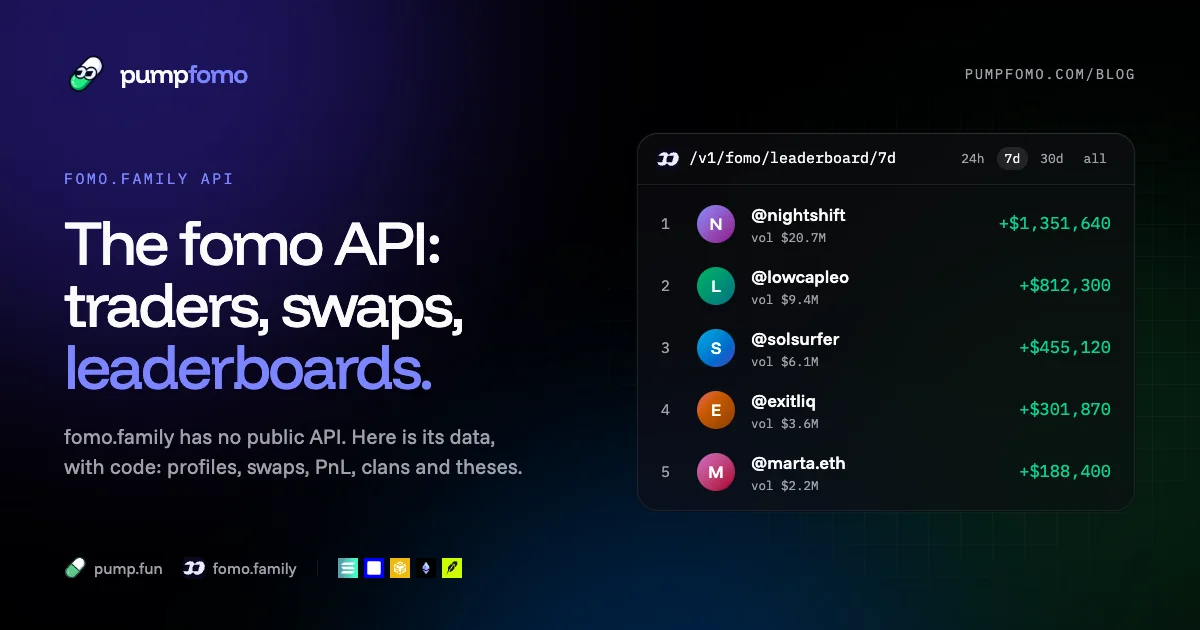
The fomo.family API: trader profiles, swaps, PnL and leaderboards from the fomo app
fomo.family has no public API. Here is what fomo data exists (traders, swaps, PnL, leaderboards, clans, theses) and how to read it with one key, with code.
Read the guide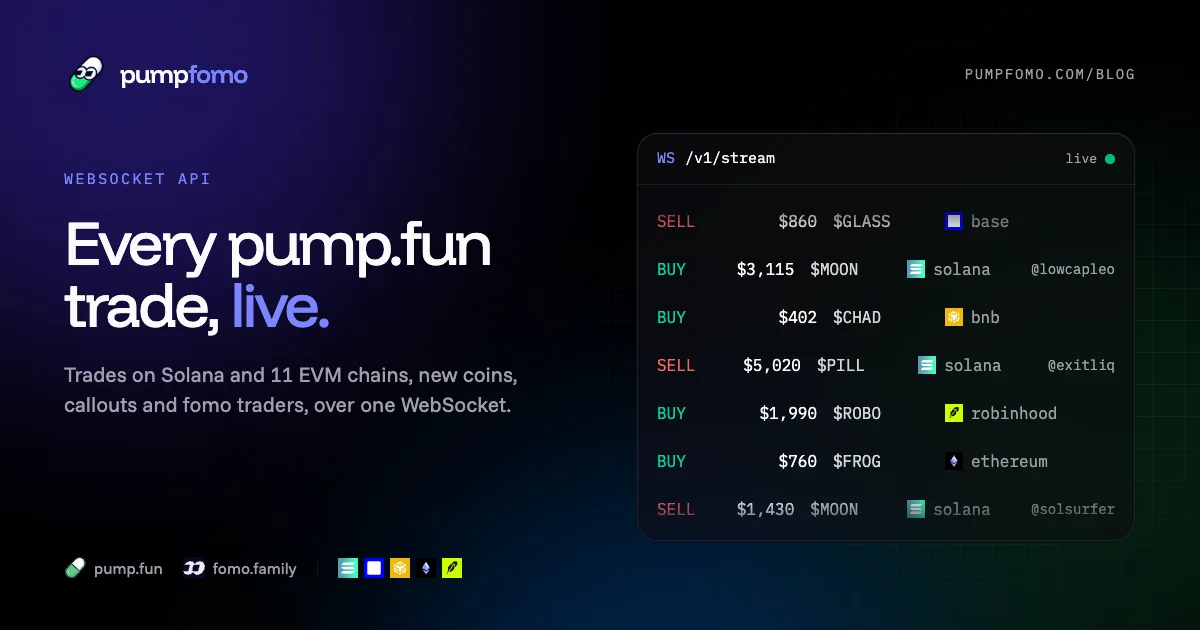
7 min read
The pump.fun WebSocket API: stream every trade, new coin and callout as it happens
Stream pump.fun trades on Solana and 11 EVM chains, new coins, callouts and fomo.family traders over one WebSocket. Channels, filters and Node and Python code.
Read the guide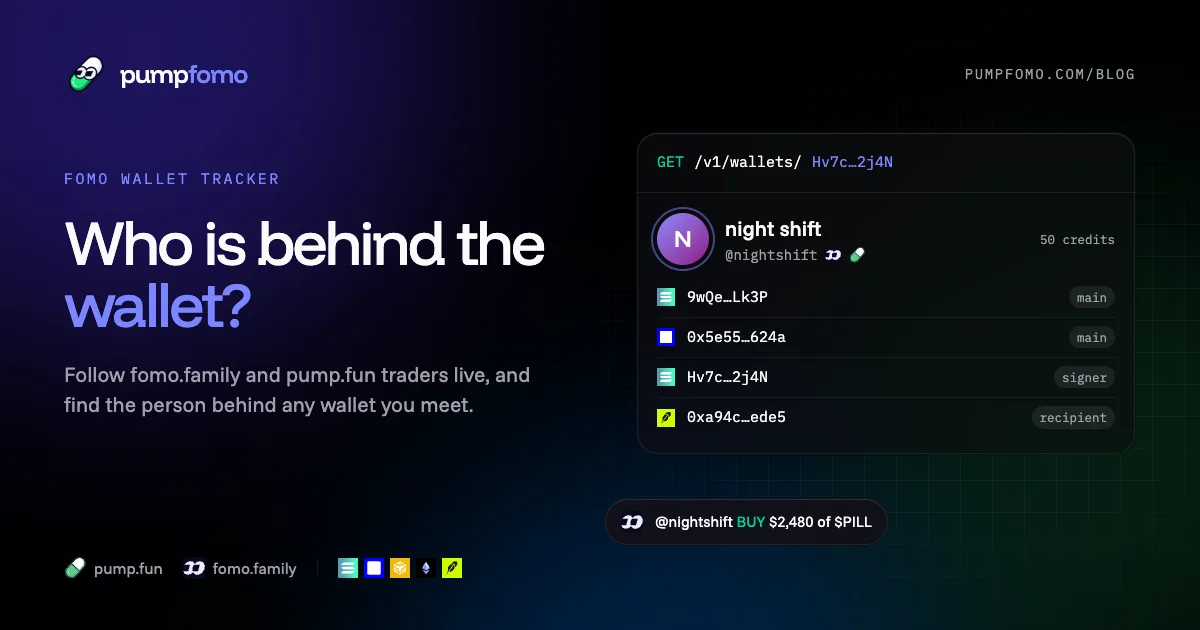
7 min read
Building a fomo wallet tracker: who is behind a wallet, and every trade a fomo trader makes
Why a fomo.family profile address won't show a trader's trades, how to follow fomo and pump.fun traders live, and how to find the person behind a wallet.
Read the guide
6 min read
How to build a pump.fun and fomo copy trading bot on a social trading API
Pick traders worth copying from pump.fun and fomo.family data, watch them live, filter their trades and size your own. A working blueprint with TypeScript code.
Read the guide