
An open-source pump.fun new coin scanner with a live dashboard
A ready-made pump.fun new coin scanner. It sees every coin the second it launches, watches its first trades live, scores its momentum and alerts you to the ones taking off. Open source, with a live demo.
18 min read
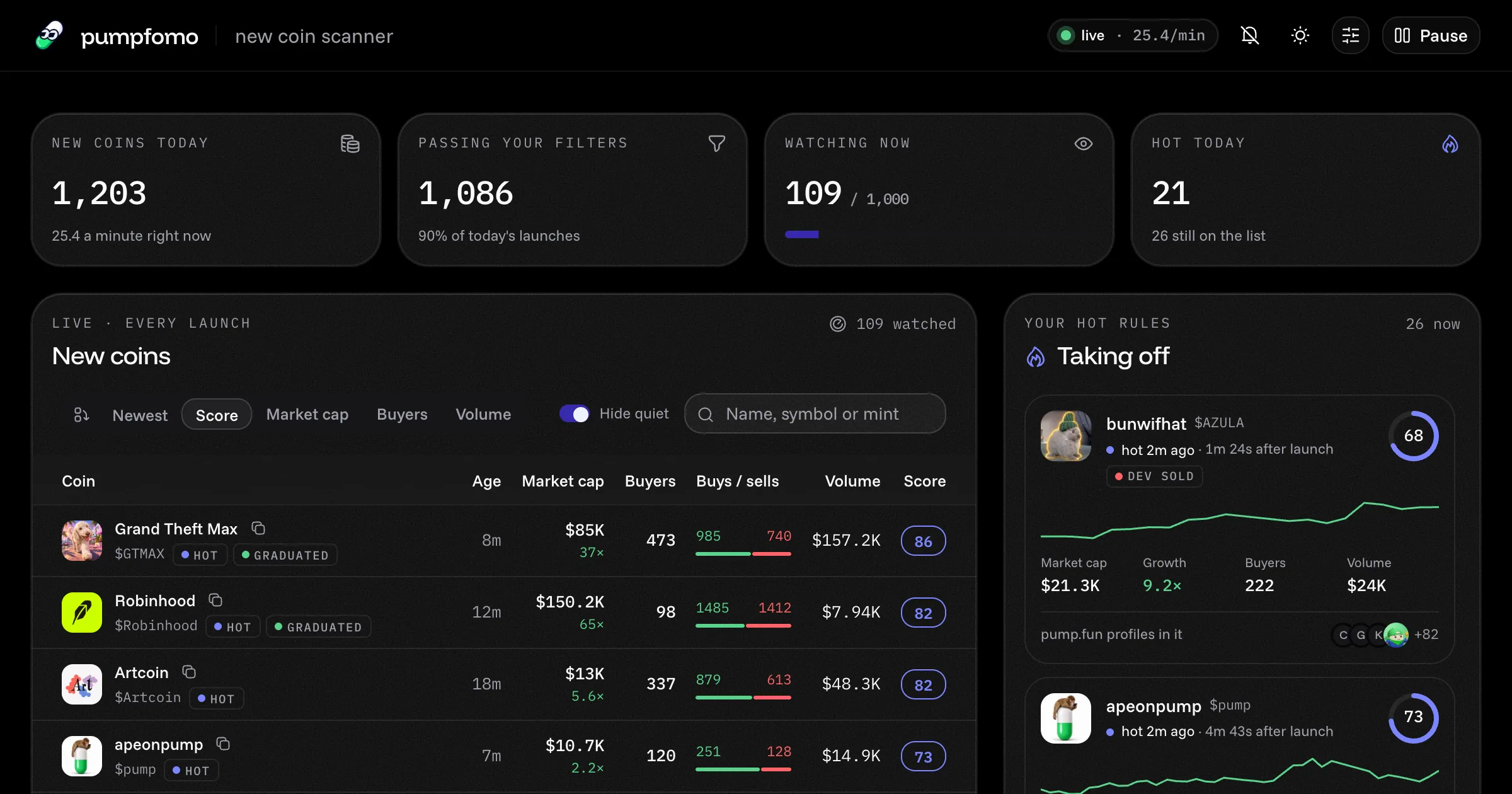
pump.fun launches dozens of coins a minute, and almost all of them go nowhere. The few that run usually show it in their first minutes: real buyers pile in, volume climbs, the market cap moves. This app watches for exactly that. It sees every coin the second it's created, follows its first trades live, scores its momentum and tells you when one takes off.
It's a complete Next.js app, open source under MIT. It doesn't trade: it finds coins, and what you do with them is up to you. Open the live demo to watch pump.fun's launches as they happen, or download the code (it's also on GitHub). This page is the full documentation: setup, every setting, how the score works, what it costs and how to fix common problems.
What it does
- Sees every new coin as it's created, about a second after launch, from the pumpfomo live stream.
- Filters for free, before any credit is spent on a coin:
- launchpad (pump.fun by default, or any you pick)
- chain (Solana by default)
- words a name or symbol must contain, or mustn't
- creators on your block list
- Mayhem Mode coins, if you like
- Watches each coin's first 30 minutes, up to 1,000 coins at once, on the same stream connection. For each coin it keeps:
- market cap, its high since launch, and how far it has come from launch
- buys and sells, and how many different wallets bought
- volume, and how much of it is buying
- whether the creator (the dev) has sold
- which traders with a pump.fun profile have traded it
- how long it took to get its first trade
- Scores momentum from 0 to 100, in five parts you can see: buyers, volume, buy pressure, growth and profiles. A dev who sold costs 20 points.
- Flags coins that take off. A coin turns hot when it meets your rules within its first minutes. By default that's 20 buyers, $5,000 of volume and a $10,000 market cap within 15 minutes. Hot coins get their own list and a toast; with alerts on, a chime and a browser notification too.
- Keeps bots out of the counts. Buys under $5 don't make a buyer, and trades by pump.fun's Mayhem agent move the price but never count as buyers or volume.
- Shows each coin's logo and market cap, looked up 50 to a batch: by default as soon as a coin gets a real buyer, or every coin if you choose.
- Opens any coin into a card with the score part by part, a candlestick chart, pump.fun's live numbers (curve progress, holders, top-10 share, dev holdings, snipers, KOLs), its links and its latest trades.
- Spends credits inside a budget you set. The stream is a flat 10 credits a minute; logos, links and coin cards stay inside an hourly cap.
- Changes settings while it runs. Filters, hot rules and budgets are edited in the dashboard and saved, with no restart.
Try the live demo
The demo runs the same app in a read-only mode:
- Every pump.fun launch shows up as it happens, with its logo and live numbers.
- Coins that take off move to the Taking off list.
- It runs with the default filters and hot rules. Nobody can change them, pause it or see the credit balance.
- It looks up every coin's logo (
ENRICH=all), which takes more credits than Builder holds. Your own copy starts withENRICH=active; see What it costs to run.
The demo starts from nothing each time its server wakes up, so its "hot today" count can sit at zero for a while. Your own copy keeps its hot coins and today's counts on disk.
What you need
| What | Why |
|---|---|
| Node.js 22 or newer | For the built-in WebSocket and fetch. |
A pumpfomo API key with the stream scope |
Create one at pumpfomo.com/dashboard/keys. Streams come with the Builder plan and up ($149 a month, or $1,249.90 a year). Free and Starter keys can't open a stream. See pricing. |
| A machine that stays on | A VPS, a home server or a container. The scanner only sees what launches while it runs. |
That's all: no wallet and no other service.
Running two apps. Each running copy of an app holds one stream, and Builder allows one at a time. To run the scanner and, say, the pump.fun copy trader together, you need 2 streams: that's Growth.
Quick start
curl -LO https://pumpfomo.com/downloads/pumpfun-new-coin-scanner.zip
unzip pumpfun-new-coin-scanner.zip
cd pumpfun-new-coin-scanner
npm install
cp .env.example .env.local
Open .env.local and set your key:
PUMPFOMO_API_KEY=pf_live_...Then start it:
npm run devOpen http://127.0.0.1:3004. On first start you should see:
- the header saying live with the coins per minute;
- new coins sliding into the New coins table within seconds;
- logos and market caps filling in as coins get their first real buyers.
The first hot coin usually shows up within the hour. To see more, loosen the hot rules in Settings. For everyday use, run the production build instead: npm run build && npm start, on the same address.
Configuration
Your key goes in .env.local. Everything else there is optional and only sets where a dashboard setting starts. When you change a setting in the dashboard, it's saved in DATA_DIR/settings.json and wins over .env.local from then on. Delete that file to go back to .env.local.
Key and storage
| Variable | Default | What it does |
|---|---|---|
PUMPFOMO_API_KEY |
– | Your pumpfomo key. Required, with the stream scope. |
DATA_DIR |
data |
Where settings, hot coins and coin logos are kept. On a serverless host: /tmp/data. |
Which coins
| Variable | Default | What it does |
|---|---|---|
LAUNCHPADS |
pump |
Launchpads to look at, comma separated (pump, bags, dbc, raydium_launchpad…). Empty: every launchpad. |
CHAINS |
solana |
Chains to look at, comma separated. Empty: every chain. |
INCLUDE_WORDS |
– | Only names or symbols containing one of these words. |
EXCLUDE_WORDS |
– | Skip names or symbols containing any of these. |
BLOCKED_CREATORS |
– | Skip coins made by these creator wallets. |
SKIP_MAYHEM |
false |
Skip coins that pump.fun's Mayhem agent trades. Its own trades never count toward buyers or volume either way. |
When a coin is hot
| Variable | Default | What it does |
|---|---|---|
MIN_BUY_USD |
5 |
A wallet counts as a buyer only from a buy of at least this many dollars. Keeps dust-buying bots out. |
HOT_WITHIN_MIN |
15 |
A coin must meet every hot rule within this many minutes of launch. |
HOT_MIN_BUYERS |
20 |
Hot rule: at least this many buyers. |
HOT_MIN_VOLUME_USD |
5000 |
Hot rule: at least this much volume. |
HOT_MIN_MCAP_USD |
10000 |
Hot rule: at least this market cap. |
HOT_DEV_HOLDING |
false |
Hot rule: the creator hasn't sold. Off by default, since most pump.fun devs sell early, runners included. |
Watching
| Variable | Default | What it does |
|---|---|---|
WATCH_MIN |
30 |
How long each new coin's trades are followed, in minutes. The stream follows up to 1,000 coins at once. |
KEEP_HOT_MIN |
120 |
How long hot coins stay on the list and keep being followed. |
Credits
| Variable | Default | What it does |
|---|---|---|
ENRICH |
active |
Which coins get a logo, market cap and links: active (a coin's first real buyer), all (every coin that passes the filters) or hot (hot coins only). |
CREDITS_PER_HOUR |
empty | The most credits an hour for logos, links and coin cards. Empty means 90, or 2,000 with ENRICH=all. The stream itself is a flat 10 credits a minute. |
Public copies
| Variable | Default | What it does |
|---|---|---|
HIDE_OFFENSIVE |
false |
true leaves coins named with slurs or hate terms off the dashboard. Always on with DEMO_MODE. |
DEMO_MODE |
false |
true makes a read-only showcase that answers any host and refuses every change. |
The Settings panel
Open Settings (the sliders icon in the header). It has the same groups as above: Which coins, Hot rules, Watching and Credits. Each field shows its range and a short explanation. Press save and the change applies at once: new filters decide which coins get watched from then on, and new hot rules are checked against every watched coin.
Using the dashboard
Header
The stream's state (live, connecting, stopped) and the coins per minute, the credits left on your account, the alerts bell, the theme switch, Settings and Pause. A paused scanner closes the stream and spends nothing; Resume opens it again.
Stats
Four cards: new coins today, how many passed your filters, how many are watched now (out of 1,000), and how many turned hot today with how many are still on the list.
New coins
Every watched coin, live:
- Coin: logo, name, symbol and a copy button for the mint, with tags such as HOT, DEV SOLD or MAYHEM.
- Age since launch.
- Market cap, and below it the growth since launch (2.0× means it has doubled).
- Buyers: different wallets with a real buy.
- Buys / sells, with a thin bar for the split.
- Volume in dollars.
- Profiles: the pictures of pump.fun traders in the coin.
- Score, from 0 to 100.
Sort by newest, score, market cap, buyers or volume, or search by name, symbol or mint. Hide quiet is on by default: it hides coins over a minute old with fewer than 3 trades, which is most of them. The table shows the top 100 rows for the sort you picked. Numbers update every second, and flash green or red when they move.
Taking off
The hot coins, newest first. Each one shows when it turned hot and how soon after launch, a market-cap sparkline, its market cap, growth, buyers and volume, and the profiles in it.
Coin card
Click any coin. The card shows:
- the score, part by part, and whether the dev has sold;
- a candlestick chart of its market cap, with 15-second bars for a coin under 15 minutes old, 1-minute bars up to 3 hours and 5-minute bars after that;
- pump.fun's live numbers: bonding-curve progress, holders, top-10 share, dev holdings, snipers and KOLs;
- links to pump.fun, DEX Screener and Solscan, and a copy button for the mint;
- the profiles in it and the latest trades.
Opening a card costs 3 credits (1 for the live numbers, 2 for the chart). It's kept for a minute, so opening it again costs nothing.
Alerts
Press the bell in the header. The browser asks once whether the page may show notifications. From then on, every coin that turns hot plays a short chime, and shows a notification when the tab isn't in front. The choice is remembered in your browser. Without alerts on, a hot coin still shows a toast.
Filters and rules, and How the score works
Two cards under the table. The first sums up what the scanner looks at, this hour's detail budget and today's launches by launchpad. The second lists the score's parts and their points.
How it works
- New coins. The app opens one connection to the pumpfomo stream and subscribes to the
coinschannel. Each new coin arrives with its mint, name, symbol, creator, launchpad, chain and launch market cap in SOL. - Filters. Coins from other launchpads or chains, with the wrong words, from blocked creators or (if you chose) with Mayhem Mode are dropped there and then, at no cost.
- Watch list. Every coin that passes joins the watch list for
WATCH_MINminutes, and hot coins forKEEP_HOT_MIN. The list holds up to 1,000 coins. - Trades. On the same connection, the app subscribes to the
tradeschannel with the watch list's mints. A newtradessubscribe replaces the last one, so the app sends the whole list again whenever it changes, at most every 2 seconds. - Numbers. Each trade updates its coin: market cap and high, buyers, buys and sells, volume, whether the creator sold, and the profiles in it.
- Score and hot rules. After each trade the coin is scored, and checked against the hot rules if it's still within
HOT_WITHIN_MINof launch. - Details. Logos, market caps and links come from coin lookups, inside the hourly budget, for the coins
ENRICHpicks. Hot coins go first. - Dashboard. The page gets a fresh snapshot once a second over server-sent events, so it stays smooth however busy pump.fun gets.
The scanner runs inside the Next.js server: instrumentation.js starts it once when the server boots.
The score
Each part comes from the coin's own trades on the stream:
| Part | Points | Full marks at |
|---|---|---|
| Buyers | 30 | 40 different wallets with a real buy (buys under MIN_BUY_USD don't count) |
| Volume | 25 | $25,000, on a log scale from $100 |
| Buy pressure | 15 | 90% of the volume is buying (nothing at half or less) |
| Growth | 20 | 8× the launch market cap |
| Profiles | 10 | 5 traders with a pump.fun profile |
| Dev sold | −20 | the creator has sold since launch |
Buy pressure and profiles count in full only from $1,000 of volume, and growth from $2,000, so a jump on a few dollars of trading doesn't score. The score never goes below 0.
The hot rules
The score ranks coins; the hot rules decide what gets flagged. They're separate on purpose: sort by score to browse, and keep the rules strict so alerts stay rare. A coin turns hot when, within HOT_WITHIN_MIN minutes of launch, it has at least HOT_MIN_BUYERS buyers, HOT_MIN_VOLUME_USD of volume and a HOT_MIN_MCAP_USD market cap, all at once. With HOT_DEV_HOLDING=true, a coin whose creator has sold before it qualifies never turns hot. Hot coins are kept on disk, so they survive a restart.
Project layout
| Path | What's in it |
|---|---|
app/page.js |
The dashboard, live through /api/events. |
app/api/ |
Routes for state, events (server-sent events), settings, pause, and a coin's details, live numbers and candles. |
components/dashboard/ |
Header, stats, coins table, hot list, coin card, chart, rules, settings and setup. |
components/ui/ |
shadcn/ui components. |
instrumentation.js |
Starts the scanner when the Next.js server starts. |
lib/runtime.js |
The one scanner per server: the stream, the scanner and the details. |
lib/scanner/scanner.js |
Filters, the watch list, each coin's numbers, the score and the hot rules. |
lib/scanner/details.js |
Logos, market caps, links and coin cards, inside the hourly budget. |
lib/scanner/store.js |
Settings, hot coins and coin logos on disk. |
lib/settings.js |
The settings the dashboard can change. |
lib/clean.js |
The offensive-name filter. |
lib/pumpfomo/ |
A small pumpfomo client: REST and the live stream. |
lib/pumpfomo and lib/scanner have no dependencies. Copy them into your own project if you want the scanner without the dashboard.
What it costs to run
An open stream costs 10 credits a minute, whatever it carries: every new coin, and the trades of up to 1,000 of them, on one connection. There's no charge per message. Left on day and night, that's 14,400 credits a day, or 432,000 a month.
Everything else comes out of the hourly budget, CREDITS_PER_HOUR:
- Logos, market caps and links may spend four fifths of it, spread evenly over the hour. A lookup is 1 credit for one coin, or 5 for a batch of up to 50. No coin is looked up twice.
- The rest is kept for the coin cards you open, at 3 credits each.
Which coins get a logo is up to ENRICH. Measured on pump.fun on 12 November 2026, about 1,325 coins an hour passed the default filters (22 a minute), 58% of them got a real buyer, and a few an hour turned hot:
ENRICH |
Coins looked up | Default budget | Credits a month, stream included | Plan |
|---|---|---|---|---|
active (default) |
about 770 an hour, 50 to a batch | 90 an hour | at most 496,800 | Builder |
hot |
a few an hour | 90 an hour | about 437,000 | Builder |
all |
about 1,325 an hour, as they launch | 2,000 an hour | about 1,390,000 | Growth |
The default line works out like this:
| What | When | Credits a month |
|---|---|---|
| The live stream | always, 10 a minute | 432,000 |
| Logos, links and coin cards | at most 90 an hour | at most 64,800 |
| SOL price and key check | every 5 minutes, and at start | free |
| Total | at most 496,800, inside Builder's 500,000 |
With active and the default budget, logos arrive in batches when pump.fun is busy: up to 50 coins about every 4 minutes, the busiest first. When it's quiet they arrive within seconds. all gives every row a logo within seconds, but that's about one credit a coin, roughly 950,000 a month on top of the stream: run it on Growth, or set a smaller CREDITS_PER_HOUR and accept that logos lag behind.
To spend less, use ENRICH=hot, lower CREDITS_PER_HOUR, or press Pause.
Running it for real
The scanner lives inside the Next.js server, so it needs a machine that stays up. Build once, then start it:
npm run build
npm start
To keep it running after you log out and bring it back after a reboot, use a process manager. With pm2:
npm install -g pm2
pm2 start npm --name pumpfun-new-coin-scanner -- start
pm2 save
pm2 startup
Or with systemd, in /etc/systemd/system/pumpfun-new-coin-scanner.service:
[Unit]
Description=pump.fun new coin scanner
After=network-online.target

[Service]
WorkingDirectory=/home/you/pumpfun-new-coin-scanner
ExecStart=/usr/bin/npm start
Restart=always
User=you

[Install]
WantedBy=multi-user.target
Then sudo systemctl enable --now pumpfun-new-coin-scanner.
Reaching the dashboard. It only answers to localhost and 127.0.0.1, on port 3004. To watch it from another machine, use an SSH tunnel instead of opening the port, then open http://127.0.0.1:3004 locally:
ssh -L 3004:127.0.0.1:3004 you@your-serverServerless hosts. Vercel functions and the like only suit a demo. The scanner sleeps when nobody has the page open, and misses whatever launches meanwhile.
A public, read-only copy. Set DEMO_MODE=true. The dashboard then answers any host, refuses settings and pause, hides the credit balance and leaves out coins named with slurs or hate terms. On a host whose files don't last, also set DATA_DIR=/tmp/data. To filter names in your own private copy, set HIDE_OFFENSIVE=true.
The pumpfomo API behind it
| Call | What for | Credits |
|---|---|---|
wss://api.pumpfomo.com/v1/stream, channels coins and trades |
every new coin, and the watched coins' trades, live | 10 a minute |
GET /v1/pump/coins/{mint} |
a coin's logo, market cap and links, when fewer than 5 are waiting | 1 |
POST /v1/pump/coins/batch |
logos, market caps and links of up to 50 coins | 5 |
GET /v1/pump/coins/{mint}/live |
the coin card: curve, holders, snipers, KOLs | 1 |
GET /v1/pump/coins/{mint}/candles |
the coin card's chart | 2 |
GET /v1/pump/sol-price |
launch market caps in USD, every 5 minutes | free |
GET /v1/ping |
checking the key and its scopes at start | free |
The two subscriptions:
{ "op": "subscribe", "channel": "coins" }
{ "op": "subscribe", "channel": "trades", "mints": ["<mint>", "<mint>"], "replay": false }
A new coin arrives like this (trimmed). market_cap is in SOL:
{
  "type": "coin",
  "mint": "<mint>",
  "name": "attention",
  "symbol": "att",
  "creator": "<creator wallet>",
  "launchpad": "pump",
  "chain": "solana",
  "market_cap": "27.96",
  "ts": 1794475183000
}
And a trade in a watched coin:
{
  "type": "trade",
  "mint": "<mint>",
  "side": "buy",
  "wallet": "<wallet>",
  "amountUsd": 15.86,
  "marketCapUsd": 2880.32,
  "trader": { "handle": "someone", "avatar": "https://…" },
  "ts": 1794474941000
}
The stream reference has every message and close code, and the pump.fun WebSocket guide walks through the channels.
Troubleshooting
"PUMPFOMO_API_KEY is not set"
Copy .env.example to .env.local, put your key in PUMPFOMO_API_KEY, and restart the app.
"pumpfomo refused the key" (401)
The key is wrong, was revoked or has expired. Copy it again from your keys, with no spaces around it, and restart.
"This pumpfomo key has no stream scope"
The key was made with limited scopes. Edit its scopes in the dashboard, or create a new key with stream.
The stream stopped with code 4003
Your plan has no stream, or all of its streams are already open elsewhere. Streams start at Builder, and Builder allows one at a time: stop the other app, or move to Growth for five.
The stream stopped with code 4002
The account is out of credits. Add credits or a pack in the dashboard, then restart. Press Pause whenever you don't need the scanner: a paused scanner spends nothing.
The stream keeps reconnecting with code 4008
The app fell behind reading the stream, which happens on a very slow or overloaded machine or connection. The app reconnects by itself. If it keeps happening, run it somewhere with a steadier connection, or watch fewer coins with a shorter WATCH_MIN or tighter filters.
No coin turns hot
That's normal for a while: most new coins never get 20 real buyers. Loosen the hot rules in Settings, or sort the table by score to see what's closest.
Rows have letters instead of logos
With ENRICH=active, a coin gets its logo after its first real buyer, and on a busy day logos arrive in batches every few minutes. If the coin card says the budget is used up, this hour's CREDITS_PER_HOUR is spent: wait a few minutes or raise it.
Numbers look low for a coin that was there at start
The scanner counts from when it saw a coin. Coins launched before it started miss their first trades.
Port 3004 is already in use
Another app is on it. Stop that app, or start this one on another port: npx next start -H 127.0.0.1 -p 3014.
Make it your own
The scanning logic is in lib/scanner, the API client in lib/pumpfomo, and both have no dependencies. Some directions:
- Trade the hot ones. Hand each hot coin to a swap, the way the pump.fun copy trader quotes and signs with Jupiter.
- Alerts where you are. Post each hot coin to Telegram or Discord from the
onHotcallback inlib/runtime.js, or use the Telegram alert bot. - Your own score. Change the parts in
Scanner.score(): weight profiles more, or add the dev's past launches fromGET /v1/pump/users/{wallet}/created-coins.
The pump.fun API guide covers the REST side, and the Claude skill helps if you build with AI.
Frequently asked questions
Is the app free?
The code is free and MIT licensed. The live data needs a pumpfomo plan with streams, Builder or higher.
How fast does it see a new coin?
About a second after the coin is created. Its trades arrive as they happen, on the same connection.
Does it buy coins for me?
No. It finds coins and alerts you. The copy trader apps show how to add swaps through Jupiter if you want to trade from it.
Can I run it on Vercel?
The read-only demo runs there. A real scanner needs a server that stays up, so run it with next start on a VPS, a home server or a container: on a serverless host it sleeps when nobody has the page open.
Why does a coin with lots of trades have few buyers?
Buys under $5 don't count as a buyer, and the trades of pump.fun's Mayhem agent never count at all. Both keep bots from inflating the numbers. You can change the $5 in Settings.
Which ENRICH mode should I use?
active, the default, if you're on Builder: coins get logos once they have a real buyer, and the month stays under 500,000 credits. hot is the cheapest. all gives every row a logo within seconds but needs Growth.
Does it see coins from other launchpads?
Yes, if you want them. The stream carries coins from several launchpads; the default filter keeps pump.fun's only. Pick others in Settings or with LAUNCHPADS, or leave it empty for all of them.
Try it on real data, free.
2,500 credits a month, wallet or Telegram sign-in, no card. Every endpoint in these guides works on the Free plan; streams start at Builder.
More apps
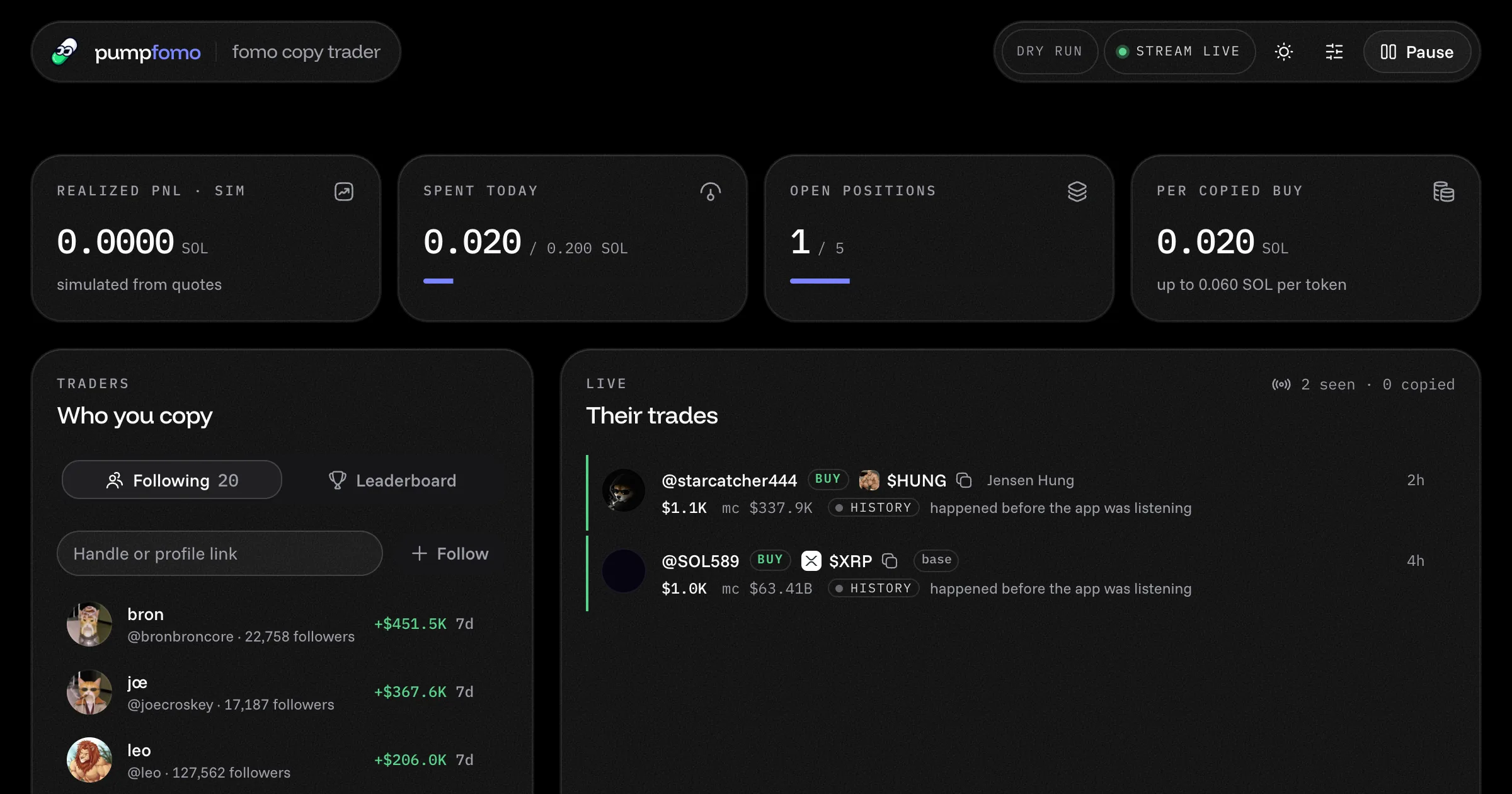
Copy fomo.family's best traders
A ready-made fomo.family copy trading bot. It follows the traders you pick, copies their Solana buys and sells within your limits, and shows everything on a live dashboard. Open source, with a live demo.
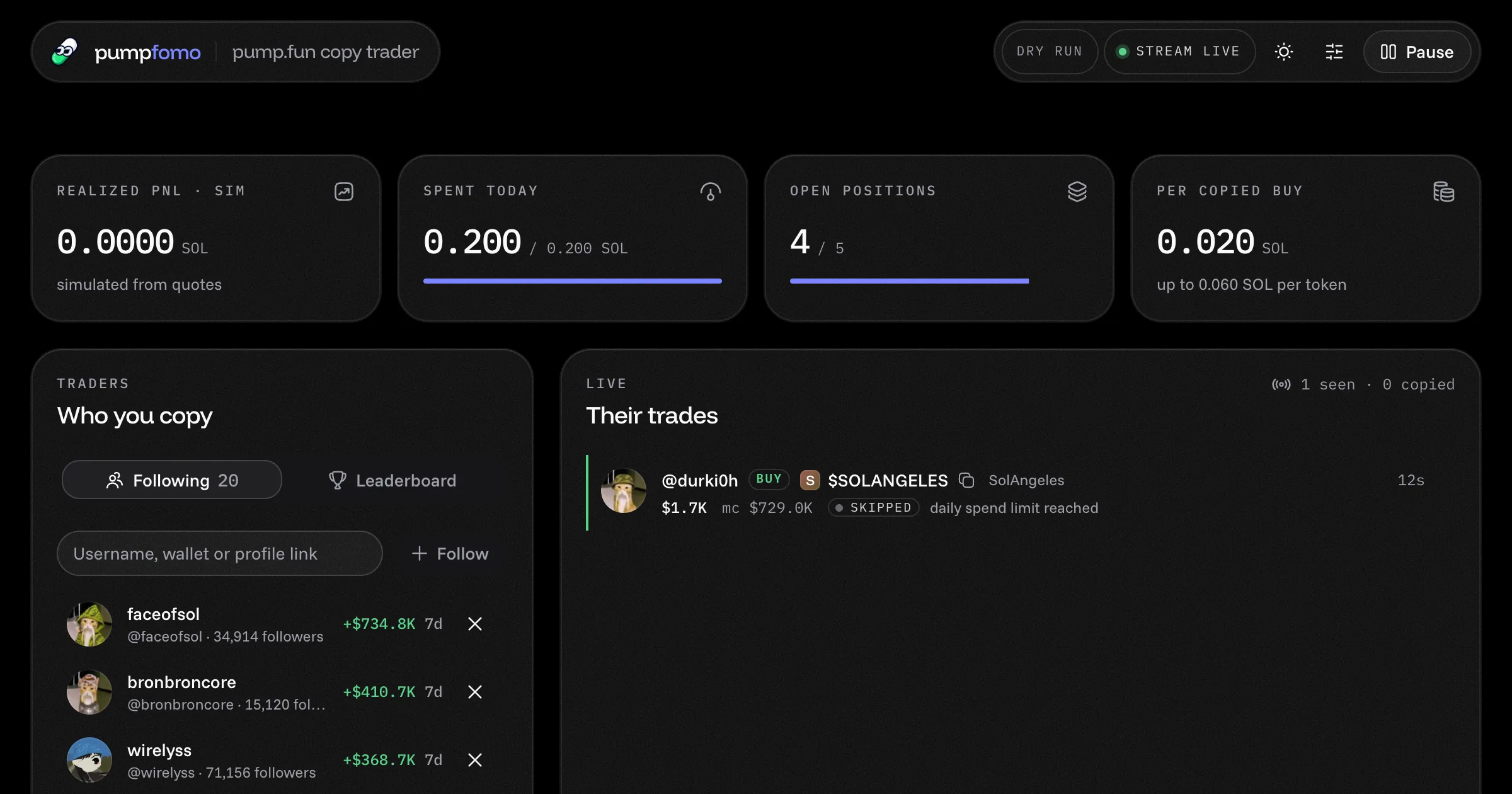
Copy pump.fun's top traders
A ready-made pump.fun copy trading bot. Follow traders by username or wallet, copy their Solana buys and sells within your limits, and watch their PnL and trades on a live dashboard. Open source, with a demo.
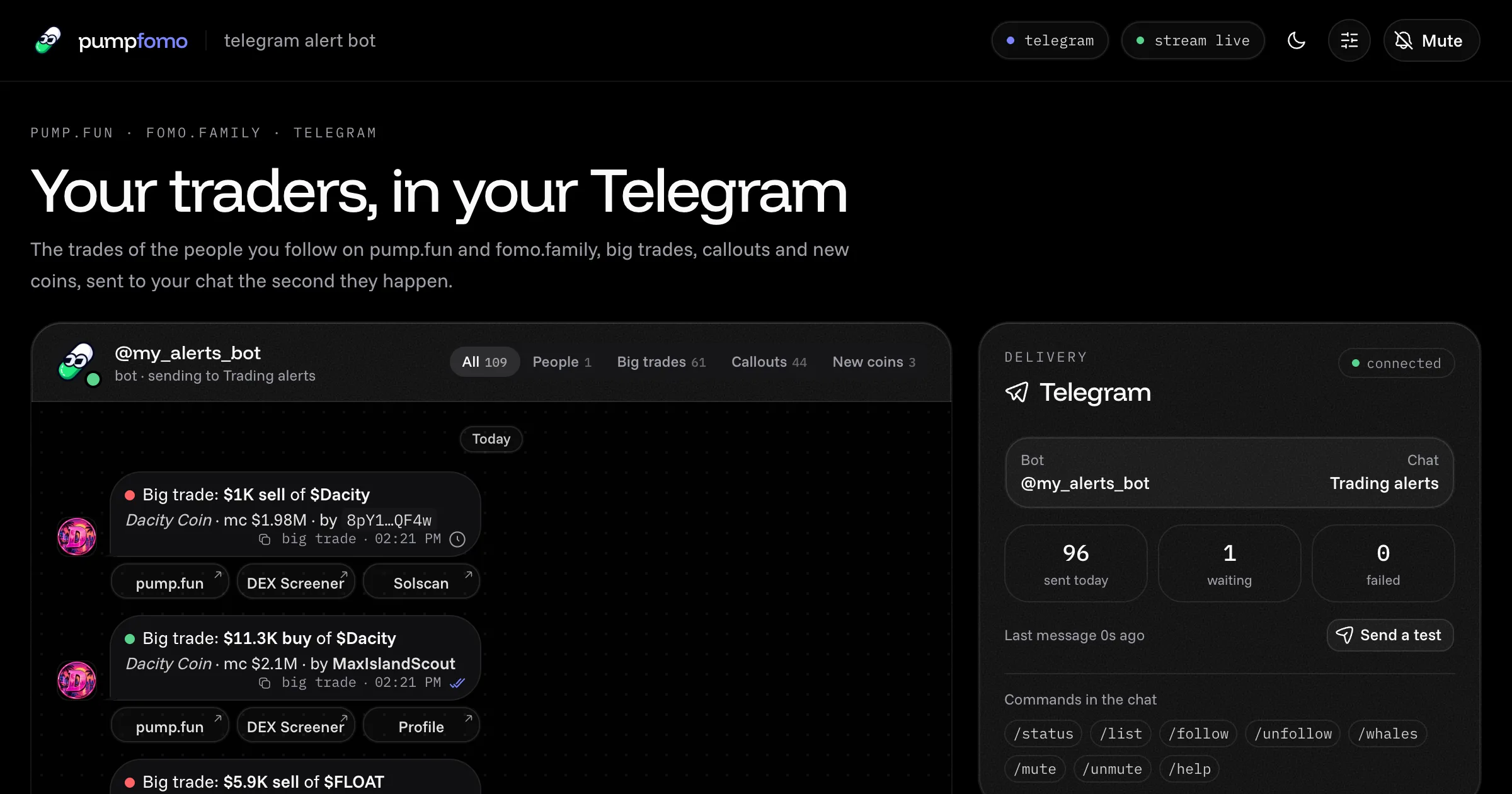
Your traders, in your Telegram
A ready-made Telegram bot that alerts you the moment the traders you follow buy or sell on pump.fun or fomo.family, plus big trades, callouts and new coins. Commands in the chat, a live dashboard, open source, with a demo.
Watch any pump.fun wallet trade
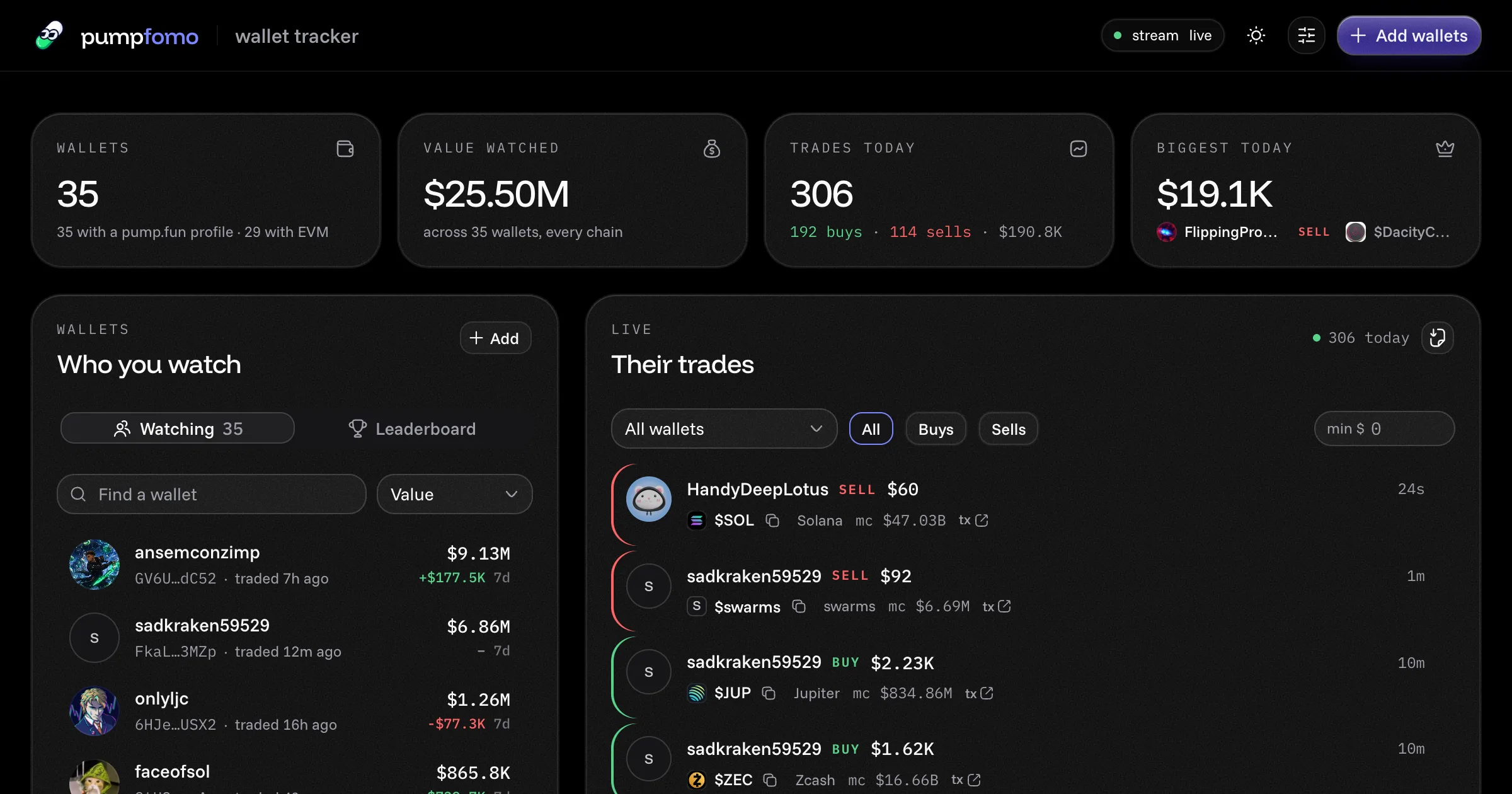
A ready-made pump.fun wallet tracker. Watch any Solana or EVM wallets, see every trade they make within a second, with each wallet's value, 7-day PnL and holdings. Open source, with a live demo.